

Introduction
The real rights have a great importance within the Italian legal system, but it is not always easy and immediate to know how to recognize and classify them correctly.
In this article we see the definition of real rights, what are the main common features and the division between property rights and minor minor rights in rem to use and real rights of warranty.
Real rights: definition and characteristics
Real rights are subjective rights that give the holder immediate and absolute power over the thing.
The characteristics common to all real rights:
- absoluteness
- immediacy
- patrimoniality
- resale right or right of sequelae – typicality
The absoluteness of real rights
The rights in rem are also called absolute rights because they can be invoked against all subjects (erga omnes), who have the obligation to refrain from disturbing the owner from the enjoyment of the good or the exercise of rights over it.
Keeping this characteristic in mind is of fundamental importance, since it is precisely this feature that distinguishes the category of absolute rights from that of relative rights.
The relative rights, in fact, can be asserted only against determined subjects (ad personam), on which it is incumbent an obligation to do or not to do a determined action or to give a determined thing.
The immediacy of real rights
Another distinctive feature of royal rights is that of immediacy.
Immediacy means the immediate power of the holder of the right to the good, without the intervention or cooperation of other subjects being necessary for the exercise of this power.
An example is that of the owner of a property right on an immovable property, who will have the right to enjoy and dispose of the property. At the same time, all the others must not behave in any way that disrupts this right.
The patrimoniality of the real rights
Rights in rem are property rights, since their content is subject to economic assessment.
Property rights are rights whose object is an economic utility deriving from the exploitation of the object.
In Italian law there is also a different category, that of non-property rights, to which belong all those rights that give the holder a non-economic advantage.
The resale right or ius sequelae
The resale right materializes in the right for the holder of the real right to pursue his right against any person, since the real right itself is linked to the good object and not to the person who has the ownership.
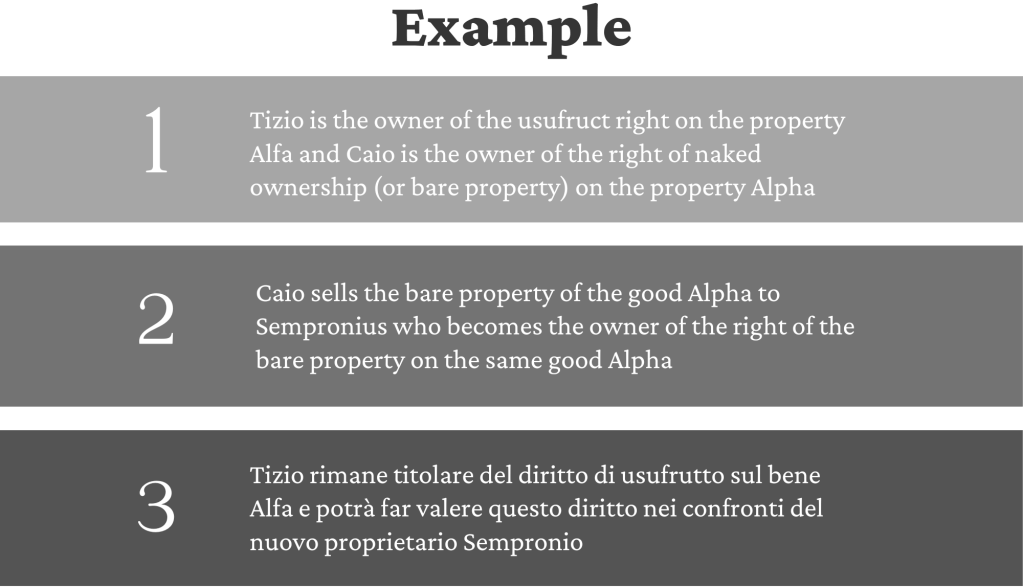
An example to better understand this characteristic may concern the case where someone is the holder of an usufruct rights on a real estate and the holder of the right of bare property sells the same property to a third party. In this case, the holder of the usufruct right can assert his right against the third party who acquires the bare property.
The typicality of real rights
Real rights are typical rights, as expressly regulated by our Civil Code; in fact, in our Legal Order, there can be no other real rights than those present in the Code.
These rights are also limited in number (numerus clausus), since it is not allowed that the parties can agree on real rights with a different content than the existing ones.
Real Right classification
Within this macro category, we can distinguish different types of rights, each having its own characteristics.
The real rights regulated by our civil code are:
- property right
- right in rem in rem to use
- real right of warranty
Property right
The property right is governed by the Civil Code by article 832 and following and is also referred to by our Constitutional Charter in article 42, which recognizes and guarantees private property.
The right to property gives its owner the right to enjoy and dispose of the objects of this in a full and exclusive way without limits other than those imposed by law (article 832 c.c.).
It is also said that the holder of this right is the full owner of the property.
Rights in rem in rem to use
The rights in rem to use, also called minor real rights, are characterized by having a more limited content and therefore the power that their holder can exercise over the object, will be more limited than the power of full ownership.
The minor rights in rem to use are:
- surface right: regulated by article 952 c.c. and following , is the right to build or to maintain a building on land belonging to others.
- right of emphyteusis: regulated by article 957 c.c. and following , gives the holder (emphyteusis) the right of enjoyment of an immovable property; the lease assumes the obligation to pay a periodic rent and improve the property itself.
- usufruct right: regulated by article 978 c.c. and following, is the right thanks to which the usufructuary can enjoy a good and derive any usefulness with the limit of respect for the economic destination of the good itself.
- right of use: regulated by article 1021 c.c., is the right to use a specific good and collect the fruits (if present) only for what is necessary to meet the needs of the right holder and his family.
- right of residence: regulated by article 1022 c.c., is the right to live in a building within the limits of the needs of the right holder and his family. For obvious reasons this right can only have as object an immovable property destined to civil habitation.
- easements: they are regulated by article 1027 c.c. and following c.c. They materialize weights or limitations imposed to a fund serving for the use of a dominant fund.
Real rights of warranty
The general principle of the guarantee is applie in italian legal system. Article 2740 c.c., in fact, establishes that all the assets of the debtor, both present and future, constitute a guarantee for the obligations that the latter must fulfill against one or more creditors.
In other words, the guarantee which is given to the creditor for the satisfaction of an obligation covers all the debtor’s assets, both present and future.
The real rights of warranty confer to the creditor, their holder, a specific guarantee which grants the creditor the opportunity to satisfy himself on certain assets belonging to the debtor’s assets if the debtor fails to fulfil his obligation.
Collateral rights are divided into:
- lien: is governed by article 2784 c.c. and following that has as object a movable property. The right of lien is constituted by the delivery to the creditor of the goods themselves or of a document conferring exclusive ownership.
- right of mortgage: is regulated by article 2808 c.c. and following, may have as object a real estate and attributes to the owner the right of expropriation of the property bound by mortgage in order to satisfy himself on the proceeds of his sale.
 The Legal Nook