

Introduction
The Italian residential and commercial real estate market is traversing a sophisticated phase of transition. A comparative analysis of the data published by the Italian Revenue Agency’s Land Registry Market Observatory (OMI) (Agenzia delle Entrate – Osservatorio del Mercato Immobiliare) for the first and second quarters of 2026 reveals critical directional trends. For international investors, institutional funds, and foreign buyers looking to relocate or expand their portfolios under Italy’s attractive tax regimes, understanding this data is paramount to mitigating risk and capturing premium value.
The macroeconomic indicators present a resilient first half of the year, with overall residential transactions growing by 2.1% to a total of approximately 381,250 trades. However, a closer look at the shift from Q1 to Q2 highlights a clear market evolution: a transition from initial acceleration to strategic consolidation.
First quarter (Q1): the momentum of market recovery
The first three months of 2026 registered strong momentum, closing with approximately 179,750 residential transaction, a solid +4.4% year-on-year increase compared to Q1 2025.
This initial surge was fueled by stabilizing credit conditions and a wave of international demand looking to capitalize on Italian lifestyle assets. From a legal and contractual perspective, Q1 saw a high concentration of final deeds (rogiti) tied to preliminary contracts signed late the previous year, proving robust investor confidence.
Second quarter (Q2): volume maturity and seasonal dynamics
The second quarter opened with a change of pace. In absolute terms, transaction volumes hit a semester peak, surpassing 201,500 transactions. This represents a 12.1% quarter-on-quarter increase, a healthy seasonal bounce reflecting traditional spring market vitality.
However, the year-on-year growth flattened to a marginal +0.1% compared to Q2 2025. This indicates that the market has reached a point of equilibrium. The initial rush has evolved into a more selective, analytical, and sophisticated buyer behavior, making rigorous legal due diligence even more decisive in negotiations.
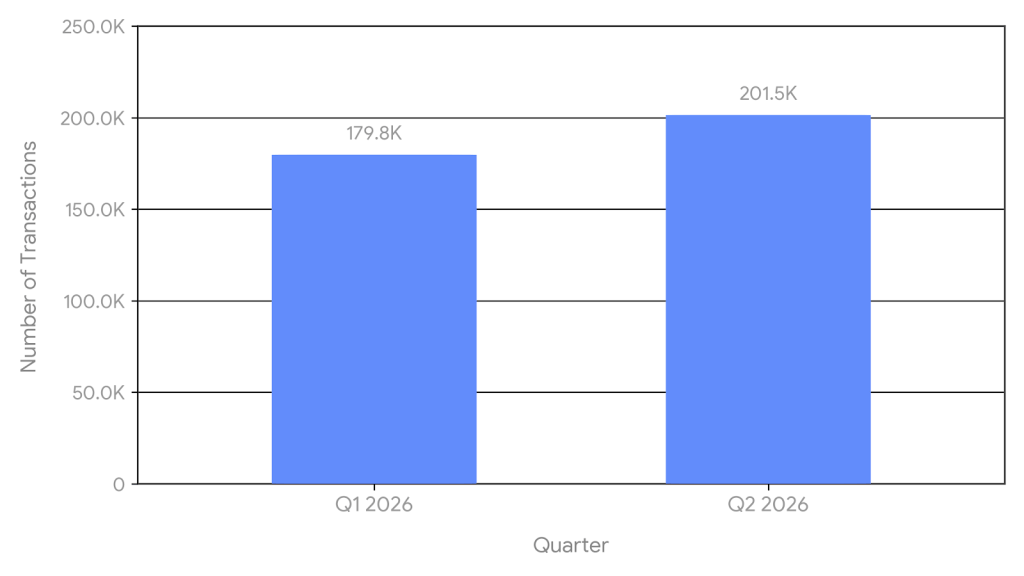
Histogram showing the volume of residential real estate transactions in Italy in the first and second quarters of 2026. Source: Italian Revenue Agency.
Market Drivers: The Energy Transition and Geographic Divergence
Two main factors are polarizing the Italian market, creating unique entry points for global capital:
- the green premium: newly built properties continue to heavily outperform the secondary market, posting a massive 30.8% year-on-year increase. Driven by European ESG mandates and the international demand for energy-efficient homes, sustainable assets have shifted from being a premium preference to a mandatory contractual and financial requirement
- geographical seletivity: the market is performing unevenly. While major metropolitan hubs maintain steady growth (+0.5%), regional areas show signs of stasis. For foreign buyers, this cross-border divergence highlights the necessity pay high attention to evaluate local municipal regulations (Piano Regolatore) before executing cross-border capital transfers.
The financial landscape: interest rates and cross-border transactions
The divergence between the two quarters aligns closely with the evolution of the Eurozone’s monetary policy through 2026. While Q1 benefited from a wave of optimism following the ECB’s initial rate cuts, Q2 saw banks adopting more stringent underwriting criteria.
For non-resident buyers seeking Italian leverage, financing has become highly seletive. Consequently, the drafting of preliminary contracts (contratto preliminare) has shifted dramatically: conditional loan clauses (clausola sospensiva) are no longer a standard formality but the absolute operational pivot ensuring the legal security of the buyer’s deposit.
Commercial eeal estate (CRE) & corporate assets
The commercial real estate sector outpaced residential growth in Q2 2026, with the non-residential market exceeding 66,000 transacted units. The retail sector led the market, fueled by institutional investments exceeding €7 billion in the first half of the year. Conversely, the office sector remained highly selective, focusing exclusively on prime Class-A assets matching international eco-certifications.
For global funds, the asymmetry between retail growth and suburban office stagnation is opening major opportunities for change-of-use redevelopments (cambio di destinazione d’uso), converting commercial layouts into premium hospitality or residential spaces.
In this case, it must always be borne in mind that in Italy, a change-of-use may only take place under certain conditions and is not necessarily always possible. In this instance, therefore, and taking current trends into account, it is always advisable to carry out a preliminary legal and technical due diligence process to ensure that the requirements for conversion are met.
Segment focus: corporate deals and executive trophy assets
The executive and corporate real estate segment has followed its own institutional logic. Transactions in this bracket are rarely structured as straightforward property sales between individuals; instead, they are heavily executed via share deals (the acquisition of the corporate vehicle holding the real estate asset) or sale and leaseback structures.
While the standard residential market showed stasis in Q2, luxury trophy assets in Milan, Rome, and Florence maintained an intense contractual appeal. From a legal perspective, the cross-border nature of these transactions demands sophisticated contractual frameworks, focusing heavily on robust Representation & Warranties (R&W) clauses, pre-acquisition environmental and zoning due diligence, and structured escrow accounts to safeguard foreign capital against latent liabilities.
Why preventive legal structuring dictates investment yield
As the Italian real estate market consolidates and becomes increasingly polarized between premium green assets and obsolete properties, legal planning is no longer a bureaucratic afterthought, it is the architecture of the deal itself.
Navigating Italy’s property landscape as a non-resident requires managing complex local frameworks, including historical building constraints (Vincolo Belle Arti), cadastral compliance verifications, and cross-border inheritance or tax optimization. For international buyers, moving forward without a comprehensive, preventative legal risk-mapping means exposing capital to administrative gridlocks or hidden liabilities that can paralyze investments for years.
The Legal Nook Insights: global investor briefing
From theory to practical negotiation. In this section, we bring together brief practical tips, case-study, guidance and strategic insights drawn from our experience in the field. Practical tools to help you navigate the complexities of the law and protect the value of your property investments.
- the “1-Euro Houses” and restoration trap: while municipal projects selling cheap regional properties attract global attention, the legal obligations attached are severe. Contracts typically mandate strict, time-bound restoration works under penalty of property forfeiture. Foreign investors must evaluate these public-private covenants with specialized counsel to avoid steep municipal penalties
- tax optimization via residency regimes: Italy’s special tax regimes for new residents (including the high-net-worth individual flat tax and incentives for inbound professionals) remain a massive driver for luxury residential real estate. Aligning the property purchase timeline with the official fiscal residency application is legally critical to maximize structural tax exemptions. Nevertheless, checking in advance whether all the requirements for these tax regimes are met saves time and money and ensures the security of the investment in the medium and long term
- “Triple Net” leases in commercial real estate: investors targeting the booming retail segment are securing yields by implementing international contract structures. Standardizing “Triple Net” commercial leases, where all extraordinary maintenance, local property taxes (IMU), and insurance costs are legally and properly menaged in total complianche with the law, isolates the foreign landlord from operational cost fluctuations.

